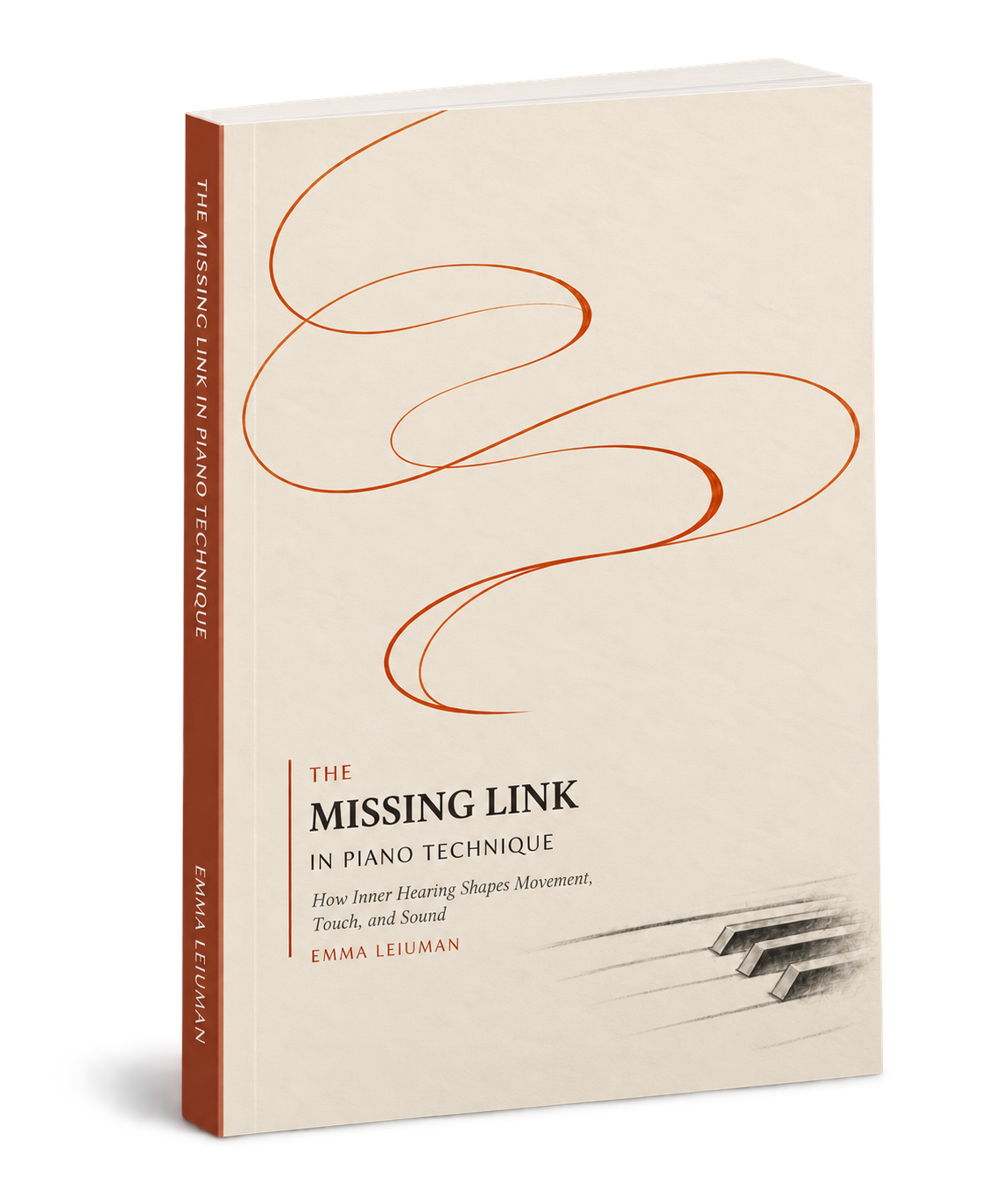
A Book by Emma Leiuman
The Missing Link in Piano Technique
How Inner Hearing Shapes Movement,Touch, and Sound
Emma Leiuman
What already exists inwardly before the key is touched—and what, exactly, is the hand responding to?
Piano teaching has developed substantial traditions for learning repertoire and organising the body. What remains comparatively undeveloped is an equally substantial, systematic discipline for the mental–physical relationship that precedes movement and sound.
About the Book
Where does piano technique begin?
Pianists are often told to hear inwardly, sing through the instrument or practise mentally. Yet these capacities are rarely developed progressively or connected in a complete way with fingering, movement, touch and artistic intention.
This book examines the largely invisible process between seeing a written note and producing a sound. Written notation becomes inwardly heard pitch. Pitch acquires timbre, sound texture and direction. Inner singing connects one musical event to the next. Movement and touch give that inward musical experience a physical path to the instrument.
Drawing on nearly thirty years of observation, playing and teaching—and on her return to the piano after focal dystonia—Emma Leiuman asks whether the mental–physical relationship deserves an equally substantial field of practice beside repertoire study and physical technique.
The Progression
From the written note to the audible sound
- 1Notation becomes internally heard pitch
- 2Pitch acquires timbre, sound texture and direction
- 3Inner singing connects one musical event to the next
- 4Several voices begin to coexist inwardly
- 5Imagined sound prepares movement and touch
- 6Physical experience refines the next inward representation
The relationship is not presented as a one-way command from mind to body. Hearing, movement, touch and the resulting sound continue to inform one another.
Contents
Inside the book
- Part IThe Visible Movement and the Invisible Cause
- Part IIBuilding the Music Before It Is Played
- Part IIIThe Physical Conditions of Expression
- Part IVRelearning the Relationship
- Part VToward Another Way of Practicing
Seventeen chapters move from the question of what the hand is responding to, through the progressive development of inner hearing, sound texture, inner singing, polyphonic hearing, movement, touch and arm weight, and finally toward the pedagogical and research questions that remain open.
A Personal and Research-Based Inquiry
Observation, experience and an open question
The book brings together personal experience, practical teaching material and existing research concerned with notational audiation, auditory imagery, mental practice and auditory–motor learning.
It does not present one pianist’s experience as a universal law. It asks whether a developmental process that has often remained private, intuitive or unnamed can be described clearly enough to be taught, observed and eventually investigated.
Formats
- PaperbackView on Amazon(opens in a new tab)
- Kindle eBookView on Amazon(opens in a new tab)

About Emma Leiuman
Emma Leiuman is a classical pianist and teacher. Born in Moscow, she studied at the Central Music School, the Moscow State Chopin College and the Moscow Tchaikovsky State Conservatory. She has performed across Russia, Germany, the United States, France and Spain, and has given lectures and masterclasses in Singapore.
Her work brings together nearly thirty years of inquiry into inner hearing, movement and artistic freedom at the piano.
Many pianists are asked to speak a musical language before they have been taught its alphabet.