Volume III · Chapter 6
Artistry
Artistry, or playing “in the zone,” is a deeply transformative state in which playing becomes more intuitive, alive, and multidimensional. Through three simple steps—Rest, Manifest, and Listen—you connect the energy of your dreams to the body and gradually surrender to your Higher-Mind, allowing the music to feel discovered rather than constructed.
- Volume
- III · Deepen Musical Language & Artistry
- Chapter
- 6
- Sections
- Theory · Step 1 · Step 2 · Step 3
- Practice Commitment
Theory · Playing “In the Zone”
You have now reached a stage where previous tasks can begin to recede into the background. Trust that they are already embedded in your body, inner singing, and mental memory.
This simplicity of focus becomes essential in performance. Under the pressure of the stage, it is impossible to consciously manage many elements at once. Focusing on the wrong things at this point—such as sound imagination or phrasing—can interfere with your ability to focus on what matters most here: Artistry.
Artistry, or playing “in the zone,” is a deeply transformative state that can be approached through the simple steps in this lesson. In this state, playing becomes more intuitive, alive, and multidimensional. Tempo, rubato, dynamics, and voicing begin to organize themselves naturally and expressively, without force or overcontrol.
The aim of this stage is to connect the energy of your dreams to the body, while learning to surrender to your Higher-Mind—to enter a more receptive state of mind. From here, music begins to feel less constructed and more discovered, as though sound and movement are being received and echoed, reflected through your playing.
On a deeper level, this process is also connected to surrender itself. A dream or desire may initiate the creative energy, but realization often requires letting go of rigid attachment to how it should unfold. When this attachment softens, the creative energy remains alive, while the mind becomes open to something larger and less predictable.
From this wider perspective, life begins to align through unexpected connections, people, and opportunities that resonate with the deeper energy behind your dreams—often in ways more meaningful than originally imagined.
Here is a brief overview of the next three steps.
- 1
“Where is my Dream to Rest?”Rest
Connect the energy of your dream to the body through the energy field and a relaxed, steady posture.
- 2
“What is my Dream to Manifest?”Manifest
Give your dream physical expression through the energy field, posture, and flowing arm motion — shifting from a static, vertical state into a dynamic, horizontal flow, like a still image coming into motion.
- 3
“Where is my Dream to Rest? — Listen.”Listen
Surrender conscious control and echo what you hear inwardly, allowing the music to come through.
Step 1 · Rest
“Where is my Dream to Rest?”
The goal of this Step is to connect dream, energy field, and posture into a relaxed and free state.
In Step 1, you will use the phrase “Where is my Dream to Rest?” to begin connecting the energy of your dream to the physical body.
The word “Dream” connects you to the energy of your needs or dreams within the elements of form, the inner storyline, and the pace of the Timing.
The word “Rest” grounds this energy into:
- a soft or dense, yet always expansive sensation, experienced physically as warmth and lightness beneath the upper arms
- a posture that is relaxed yet steady: the crown of the head gently lifted upward, the chin slightly lowered, and the shoulders and thighs loose
You will then mentally play through the piece while gently shaking the shoulders and thighs, helping imprint this sense of relaxation into your inner sensations.
Continue gently echoing the guiding question inwardly until your attention settles primarily on the words “Dream” and “Rest,” allowing the remaining words to gradually fade into the background.
Use this question only as a tool for entering or re-entering the zone. Once the state is established, let the question disappear naturally. Repeating it unnecessarily after entering the flow may interrupt the experience.
Always maintain the correct sequence of focus: dream → energy field → posture. Beginning with posture first can disturb the balance of the experience and create a more fragmented, unfocused state.
Dream
At this stage, it becomes important to translate conceptual terms—such as dream, musical form, and timing—into direct feeling. The practice is no longer about thinking the words themselves, but about sensing the feelings they represent in the correct sequence. For example, instead of internally saying “dream, form, timing,” you might feel “peaceful, beginning, animated.”
Energy field
The energy field manifests in the body as a light, warm, and soft sensation beneath the upper arms.
It is important to understand that, during louder dynamics in denser musical textures, shifting into a denser and warmer energy field can greatly support powerful yet effortless forte playing.
By contrast, maintaining a more transparent and light energy field in those intense passages may create a sensation of weakness in the hands, leading to excessive finger effort and unnecessary tension in order to produce forte sound.
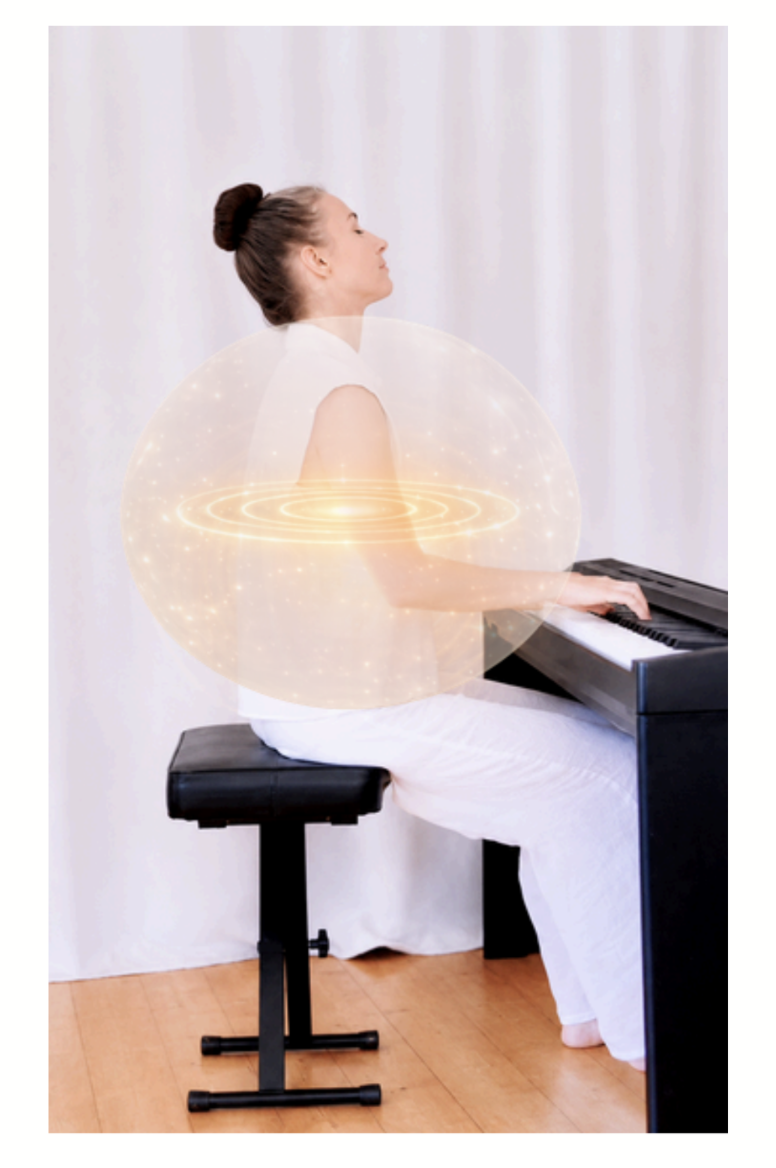
Refining Posture and Gaze
In the “Rest” step, it is important to maintain the correct order of attention. First, sense the energy field. Only then, within that field, become aware of posture. Beginning with posture first may disturb the unity and continuity of the Rest state.
You may slightly refine the posture. Instead of lifting only from the crown of the head, gently raise the area of the third eye and allow the chin to lift slightly as well. This subtle adjustment can later support greater openness and freedom in Step 3, helping expression feel more natural and effortless.
Also pay attention to the position of the eyes. Find a comfortable balance and natural angle for the gaze. Let the eyes rest softly downward and slightly to the side, creating a calm, simple, and composed presence. You may also allow the head to tilt slightly toward the register you are playing in, helping the posture and position of the eyes feel more natural and comfortable.
Practice
Day 1
Practice each step through the entire piece at a slow tempo.
Marking the Score
Fingering
Position-Change Notes
MarkingsWrite down the fingering in the score as you play using an intuitive pedal.
Mark position-change notes and add the pedal indications in the score.
Optional
Hand Motion
You may play through the piece using 3D wrist motion and elbow motion, gently releasing the fingers on the circled notes.
Later, once you feel confident with these skills, this step will no longer be necessary.
Instead, on the following day, you'll move straight to playing with correct hand motion — after first imagining every note in its sound texture.
Day 2
Hands Separate
Pre-practice
Mindset Session
Breathwork, meditations, journaling.
Manifestation (clarify your needs - the energy of your 'dreams').
Sound Texture
ImaginationImagine each note in sound texture, combining it with sound movement & glissando between notes.
Sound Texture
PlayingPlay the piece with 3D hand motion and posture, sound imagination, intonation & weight, and articulations.
Hands Together
Sound Texture
ImaginationImagine the notes in both staves in sound texture with sound movement and glissando.
Sound Texture
PlayingPlay the piece with 3D hand motion and posture, sound imagination, intonation & weight, and articulations.
Energy
ImaginationImagine the notes in both staves in sound texture with sound movement and glissando, infusing each note with the energy of your needs / dreams.
Energy
PlayingPlay the piece with 3D hand motion and posture, sound imagination, intonation & weight, and articulations, infusing each note and intonation with the energy of your needs / dreams.
Day 3
Hands Together
Reconnecting
with the Day 2 Foundations
Play through the piece with your attention on the Day 2 tasks, gently reminding yourself of the layers you embedded into your imagination and muscle memory the previous day. This will help you maintain clarity as you add the new Day 3 layers.
Harmony
ImaginationImagine the notes in both staves in sound texture & harmony, with sound movement and glissando.
Listen to the harmony and feel its emotional colour.
Then, imagine the notes as they are written in the score in sound texture and harmony with sound movement and glissando while holding the block chord with the sustain pedal. Imagine passing notes in the same harmony.
Next, imagine the notes again after you release the sustain pedal that was holding the block chord.
Imagine the notes in sound texture and harmony with sound movement and glissando.
Harmony
PlayingPlay the piece with 3D motion, sound imagination, intonation & weight, and articulations.
Trust that hand motions, intonation, arm weight, articulations, and posture are in your muscle memory. So you can now focus more attentively on the sound imagination of harmony.
Hands Together
Harmony & Dynamics
Markings & ImaginationMark the dynamics in the score.
1. Highlight the existing written dynamics to keep them visually and mentally prominent.
2. Cross out vague instructions such as dim. or cresc., and replace them with the specific dynamics you intend for each bar or section.
3. Remove hairpins except for those that begin and end with explicit written dynamics. Treat these as true dynamic transitions and write the exact dynamic markings, just as you would in other crescendo or diminuendo passages.
Then imagine the notes in sound texture, harmony, and dynamics, adding sound movement and glissando.
Harmony & Dynamics
PlayingPlay the piece with 3D motion, guided by sound imagination. Intonate each interval with arm weight and articulations.
Trust that the hand motions, intonation, arm weight, articulations, and posture are already anchored in your muscle memory. This allows you to focus more fully on the sound imagination of harmony and dynamics.
When playing forte at a slow tempo, increase the amplitude of the 3D wrist motion so that it reflects the energy of the imagined loud sound, helping the hands and tone remain free of harshness.
When playing piano, remember that you still need the full amount of arm weight to maintain control of touch and tone.
Throughout, keep the hands light, empty, weak, and loose, and allow sound imagination—rather than physical force—to guide the movement.
Day 4
Hands Together
Reconnecting
with the Day 3 Foundations
Play through the piece with your attention on the Day 3 tasks, gently reminding yourself of the layers you embedded into your imagination and muscle memory the previous day. This will help you maintain clarity as you add the new Day 4 layers.
Harmony
Dynamics
Voicing
ImaginationDecide which voice to project the most.
Avoid voicing embellishments and ornamentation.
Imagine the notes in sound texture, harmony, dynamics & voicing, with sound movement and glissando.
Remember to imagine longer notes with their full duration.
Harmony
Dynamics
Voicing
PlayingPlay the piece with 3D motion, guided by sound imagination, intonation & arm weight, and articulations.
The amplitude in hand motion will be reduced, adjusting to more subtle nuances of sound you intend to produce.
Energy
ImaginationImagine the notes in both staves in sound texture, harmony, dynamics & voicing, with sound movement and glissando, infusing each note with the energy of your needs / dreams.
Energy
PlayingPlay the piece with 3D motion, sound imagination, intonation & arm weight, and articulations, infusing each note and intonation with the energy of your dreams.
Day 5
Hands Together
Reconnecting
with the Day 4 Foundations
Play through the piece with your attention on the Day 4 tasks, gently reminding yourself of the layers you embedded into your imagination and muscle memory the previous day. This will help you maintain clarity as you add the new Day 5 layer.
Musical Speech
PlayingPlay the piece with 3D motion, guided by sound imagination. Intonate each interval with arm weight, articulations, and musical speech.
Trust that sound imagination, hand motions, intonation & arm weight, and articulations are in your muscle memory.
It may feel complex and overwhelming to intonate musical speech in both hands at the same time. For this reason, focus on one hand only—typically the one carrying the more active melodic line.
Direct your attention to intonating musical speech within the melody, rather than trying to apply it equally to both hands.
Phrasing
StructureAnalyze the phrasing in the score by marking motifs, phrases, and sentences.
Listen to the piece with attention to your phrasing choices, using this to confirm and refine your interpretation.
Give yourself the freedom to refine your phrasing structure over the coming days.
Motifs
Sing each motif out loud, and then internally.
Play the piece by motifs, allowing a natural slowing as you approach the main interval in a motif. Sense musical speech in both hands within main intervals. A natural change in dynamics may also occur. After each motif, pause briefly without lifting your hands, allowing a full release of energy. Begin the next motif from a neutral, empty state.
Direct your attention to intonating musical speech within the melody, rather than trying to apply it equally to both hands.
Phrases
Sing each phrase out loud, and then internally.
Play the piece by phrases. Play the main motif in the phrase with slightly more volume. After each phrase, pause briefly without lifting your hands, allowing a full release of energy. Begin the next phrase from a neutral, empty state.
When playing at the level of phrases, you may naturally find yourself moving at a slightly faster tempo, helping you perceive the unity of the motifs within the phrase.
Sentence
Sing each sentence out loud in a single breathe, and then internally.
Play the piece by sentences. Play the main phrase in the sentence with slightly more volume. After each sentence, pause briefly without lifting your hands, allowing a full release of energy. Begin the next sentence from a neutral, empty state.
When playing by sentences, you may naturally find yourself moving at a slightly faster tempo, helping you perceive the unity of the phrases within the sentence.
When first applying phrasing in playing, allow for greater freedom—slightly faster tempo and clearer dynamic contrast. Once the energy and flow are established, gradually slow the tempo and shift your focus toward sound imagination, refining the dynamics.
Day 6
Hands Together
Reconnecting
with the Day 5 Foundations
Play through the piece with your attention on the Day 5 tasks, gently reminding yourself of the layers you embedded into your imagination and muscle memory the previous day. This will help you maintain clarity as you add the new Day 6 layer.
Musical Image
PlayingPlay the piece focusing on the musical image (energy of your dream).
Play at a slow tempo.
Trust that musical speech and phrasing are already present in your muscle memory.
Musical Form
StructureChoose sections in the piece ranging from half a page to two pages.
Identify how many sentences each section contains, and select a suitable form template.
Musical Image
Musical Form
PlayingMentally play through the piece, sensing the musical image and form within each sentence. Focus less on individual notes and more on moving through the elements of form, sensing the energy behind them.
Play the piece, allowing the musical image and form to guide your intonation.
Play at a moderate tempo (around 2–3 notes per second). The focus is on sensing how the energy of the musical image and form is expressed through the intonation between the notes.
Let go of previous steps and shift your focus entirely to expressing musical phrasing and form through your body—using arm motions, dynamics, and flexible timing to convey every nuance and contrast.
Musical Image
Musical Form
Timing
Mental practiceLook at the time signature and tempo markings to identify the pulsation and tempo.
It may help to experience the timing physically rather than only imagining it mentally through breathing aligned with the inner pulse: exhale on the stronger beats and inhale on the lighter beats of the chosen timing.
Mentally play through the first two bars of each element of form in the piece, focusing on how these blocks are felt within musical image, form, and timing.
Be very clear in your inner sensations about the feeling of each form element and every tempo change.
Musical Image
Musical Form
Timing
PlayingPlay the piece while focusing on musical image, form, and timing.
Begin with a slower timing, regardless of the original tempo in the score, knowing that the piece will gradually be brought to its intended tempo during the Learning Stage.
Day 7
Freedom in Posture and Shoulders
Repeat each section 3-5 times without aiming for full memorization at this stage.
every sentence
every 2 sentences
every 4 sentences
every 8 sentences
the whole piece, or a larger section (3–5 pages)
Before Playing
Before playing, focus on:
Dream (needs, form, timing) → Energy Field → Posture with relaxed shoulders.
Mentally play through the piece while gently shaking the shoulders.
While Playing
While playing, return to the question:
“Where is my Dream to Rest?”
Shoulder and upper arm motions may look and feel exaggerated at this stage. This is completely normal.
Before Playing
Focus on the phrase: “Where is my Dream to Rest?”
Remember the sequence of attention:
- 1
Dream
- 2
Energy field
- 3
Posture
“Rest” involves more than energy field and posture alone. It represents the merging of the Dream energy with the physical state of the body.
When connecting to the Dream element, it may help to experience the timing physically rather than only imagining it mentally.
One way to do this is through breathing aligned with the inner pulse:
- Exhale on the stronger beats of the chosen timing.
- Inhale on the lighter beats of the chosen timing.
Taking three full breaths in this way before beginning the phrase “Where is my Dream to Rest?” can already help the heartbeat settle into the frequency and character of the intended tempo.
Once you begin playing, however, there is no need to continue consciously focusing on the breathing, as this may distract from the main focus of Step 1. Use it only as an initial preparation.
Mentally play through the piece while maintaining the right inner sensations, keeping the posture aligned, and gently shaking the shoulders to deepen relaxation.
While Playing
After this mental preparation, you are ready to play.
Think of the mind as a highly responsive system: when given clear instructions, it naturally begins to follow them. For this reason, before playing, become completely clear about the inner state you want your mind and body to enter.
During playing, distracting thoughts may begin to cloud your focus—thoughts about the past or future, or attention shifting toward unrelated musical elements such as sound texture or phrasing.
Your main task is simply to return to the central question whenever you feel yourself leaving the zone: “Where is my Dream to Rest?”
Shoulder and upper arm motions may look and feel exaggerated at this stage. This is completely normal.
Step 2 · Manifest
“What is my Dream to Manifest?”
While Step 1 focused on relaxation, posture, and grounding, Step 2 introduces freedom and flow in the arms.
In Step 2, you will introduce additional physical sensations through the phrase “What is my Dream to Manifest?”
Here, “Dream” becomes connected to “Manifest,” representing the physical expression of your dream energy through your energy field, posture, and flowing arm motion. This shifts your focus from a more static, vertical state into a dynamic, horizontal one—similar to the transition from a still image into moving film.
Again, mentally play through the piece while exaggerating the flow of your arm movements to reinforce this sensation.
The phrase “What is my Dream to Manifest?” builds upon everything established in Step 1. The Dream still includes your needs and desires, musical form, timing, energy field, and posture.
The word “Manifest” now adds movement—specifically the free flow of the elbows through broad, conducting-like motions.
These elbow movements should feel open and effortless, following the main points of elbow movement previously marked in the score.
Unlike Step 1, which focused on grounding and rest, Step 2 introduces a stronger sense of horizontal flow and movement through the music. The arms begin to move freely within the energy field already created in the previous step.
Continue gently echoing this question inwardly until your attention settles mainly on the words “Dream” and “Manifest,” allowing the remaining words to fade into the background.
Freeing the Arms Through Conducting
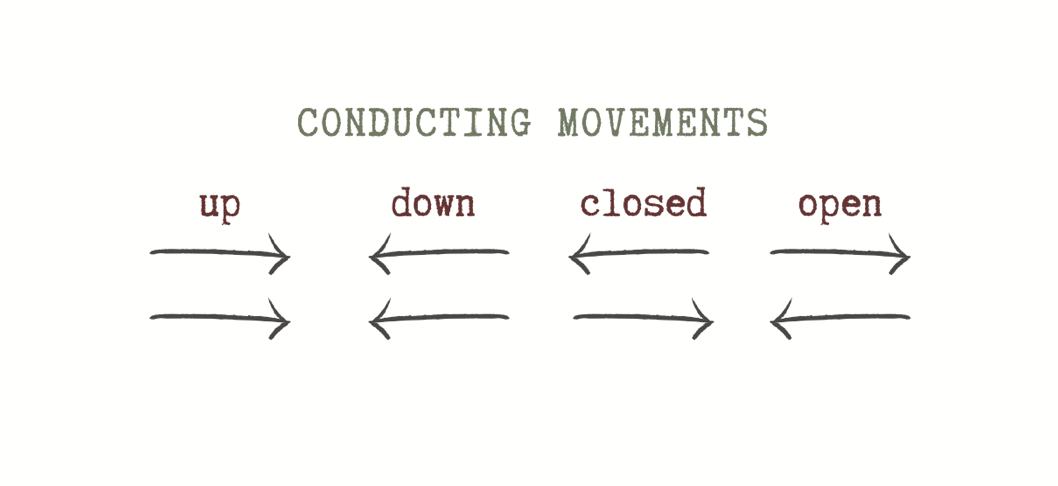
When performing, especially at the beginning, it is common to feel that the energy is held back. This can make the elbows feel stiff, restricted, or hesitant in movement.
To overcome this and support greater technical freedom, it is important to consciously free the motion of the elbows both before and during playing.
This helps release tense and restrained energy, while also improving ease and accuracy in larger movements and leaps.
When mentally refining conducting motions, synchronize them with the inner pulse:
- In 4/4 time, allow the movement to follow all four beats of the measure.
- In alla breve, conduct in two larger beats if pulsing by half notes.
This approach feels more natural and integrates smoothly with the continuous inner pulsation of the Dream element.
Between these main beats, you may introduce additional movements in passages with more intricate turns, directional changes, or leaps that require more conscious elbow motion.
While mentally playing through the piece with focus on Dream and conducting, allow the eyes and mind to glide freely through the score.
Rather than concentrating on individual notes, perceive the music as flowing patterns—like waves in the ocean rather than separate drops of water. This prevents confusion when the direction of the conducting motion differs from the movement of individual notes.
Make sure the conducting motion remains completely free of tension. Move the arms lightly, freely, and with good amplitude. Slow or tense movements contradict the main purpose of this exercise, which is to develop freedom and lightness in the arms while playing.
Practice Structure
At this stage, the practice structure remains similar to Step 1. Begin with single sentences, then gradually combine them into groups of two, four, and eight sentences, eventually working through larger sections of the piece—around three to five pages.
Repeat each section until it becomes memorized. Memorization becomes especially important at this stage, since constantly returning to the score can interrupt the continuity of focus needed for Step 3.
Conducting
Clarify the movements
Before playing, first clarify the elbow motion pattern:
- Identify the main conducting movements and simplify them as much as possible, following the beat or half-bar.
- Add additional motion only when technically required, such as in jumps, turns, or more complex passages.
Conduct physically
While mentally playing through the section, maintain the correct inner sensations and conduct following the elbow motion pattern.
Physically conduct the section while focusing on everything established in Step 1—dream, energy field, and posture—together with the free movement of the elbows.
The motion should feel swift, open, relaxed, simple, and clear—never slow or tense. The more clearly you express the motion externally, the easier it becomes to sense internally.
Repeat the section multiple times to help the body and muscle memory absorb the motion pattern.
Then mentally rehearse the movements. Mentally go through the conducting motions while focusing on everything established in Step 1—dream, energy field, and posture.
Before Playing
Focus on the guiding question: “What is my Dream to Manifest?”
Maintain the correct sequence of attention:
- “My Dream” refers to Step 1 — dream, energy field, and posture
- “To Manifest” refers to free, flowing elbow motion with broad amplitude
While Playing
During playing, distracting thoughts may begin to cloud your focus—thoughts about the past or future, or attention shifting toward musical elements unrelated to this stage, such as sound texture or phrasing.
Whenever you feel yourself leaving the zone, simply return to the central question: “What is my Dream to Manifest?”
Repeat each section until it becomes memorized.
Memorization becomes especially important at this stage, since constantly returning to the score can interrupt the continuity of focus required for Step 3.
Remain in a comfortable Timing 2 pace and without yet bringing the sections to their original fast tempo.
At this stage, the elbow motions may appear and feel exaggerated. This is completely normal, as in Step 3 these movements will gradually settle more deeply into the inner muscular sensations.
Practice
Day 1
Practice each step through the entire piece at a slow tempo.
Marking the Score
Fingering
Position-Change Notes
MarkingsWrite down the fingering in the score as you play using an intuitive pedal.
Mark position-change notes and add the pedal indications in the score.
Optional
Hand Motion
You may play through the piece using 3D wrist motion and elbow motion, gently releasing the fingers on the circled notes.
Later, once you feel confident with these skills, this step will no longer be necessary.
Instead, on the following day, you'll move straight to playing with correct hand motion — after first imagining every note in its sound texture.
Day 2
Hands Separate
Pre-practice
Mindset Session
Breathwork, meditations, journaling.
Manifestation (clarify your needs - the energy of your 'dreams').
Sound Texture
ImaginationImagine each note in sound texture, combining it with sound movement & glissando between notes.
Sound Texture
PlayingPlay the piece with 3D hand motion and posture, sound imagination, intonation & weight, and articulations.
Hands Together
Sound Texture
ImaginationImagine the notes in both staves in sound texture with sound movement and glissando.
Sound Texture
PlayingPlay the piece with 3D hand motion and posture, sound imagination, intonation & weight, and articulations.
Energy
ImaginationImagine the notes in both staves in sound texture with sound movement and glissando, infusing each note with the energy of your needs / dreams.
Energy
PlayingPlay the piece with 3D hand motion and posture, sound imagination, intonation & weight, and articulations, infusing each note and intonation with the energy of your needs / dreams.
Day 3
Hands Together
Reconnecting
with the Day 2 Foundations
Play through the piece with your attention on the Day 2 tasks, gently reminding yourself of the layers you embedded into your imagination and muscle memory the previous day. This will help you maintain clarity as you add the new Day 3 layers.
Harmony
ImaginationImagine the notes in both staves in sound texture & harmony, with sound movement and glissando.
Listen to the harmony and feel its emotional colour.
Then, imagine the notes as they are written in the score in sound texture and harmony with sound movement and glissando while holding the block chord with the sustain pedal. Imagine passing notes in the same harmony.
Next, imagine the notes again after you release the sustain pedal that was holding the block chord.
Imagine the notes in sound texture and harmony with sound movement and glissando.
Harmony
PlayingPlay the piece with 3D motion, sound imagination, intonation & weight, and articulations.
Trust that hand motions, intonation, arm weight, articulations, and posture are in your muscle memory. So you can now focus more attentively on the sound imagination of harmony.
Hands Together
Harmony & Dynamics
Markings & ImaginationMark the dynamics in the score.
1. Highlight the existing written dynamics to keep them visually and mentally prominent.
2. Cross out vague instructions such as dim. or cresc., and replace them with the specific dynamics you intend for each bar or section.
3. Remove hairpins except for those that begin and end with explicit written dynamics. Treat these as true dynamic transitions and write the exact dynamic markings, just as you would in other crescendo or diminuendo passages.
Then imagine the notes in sound texture, harmony, and dynamics, adding sound movement and glissando.
Harmony & Dynamics
PlayingPlay the piece with 3D motion, guided by sound imagination. Intonate each interval with arm weight and articulations.
Trust that the hand motions, intonation, arm weight, articulations, and posture are already anchored in your muscle memory. This allows you to focus more fully on the sound imagination of harmony and dynamics.
When playing forte at a slow tempo, increase the amplitude of the 3D wrist motion so that it reflects the energy of the imagined loud sound, helping the hands and tone remain free of harshness.
When playing piano, remember that you still need the full amount of arm weight to maintain control of touch and tone.
Throughout, keep the hands light, empty, weak, and loose, and allow sound imagination—rather than physical force—to guide the movement.
Day 4
Hands Together
Reconnecting
with the Day 3 Foundations
Play through the piece with your attention on the Day 3 tasks, gently reminding yourself of the layers you embedded into your imagination and muscle memory the previous day. This will help you maintain clarity as you add the new Day 4 layers.
Harmony
Dynamics
Voicing
ImaginationDecide which voice to project the most.
Avoid voicing embellishments and ornamentation.
Imagine the notes in sound texture, harmony, dynamics & voicing, with sound movement and glissando.
Remember to imagine longer notes with their full duration.
Harmony
Dynamics
Voicing
PlayingPlay the piece with 3D motion, guided by sound imagination, intonation & arm weight, and articulations.
The amplitude in hand motion will be reduced, adjusting to more subtle nuances of sound you intend to produce.
Energy
ImaginationImagine the notes in both staves in sound texture, harmony, dynamics & voicing, with sound movement and glissando, infusing each note with the energy of your needs / dreams.
Energy
PlayingPlay the piece with 3D motion, sound imagination, intonation & arm weight, and articulations, infusing each note and intonation with the energy of your dreams.
Day 5
Hands Together
Reconnecting
with the Day 4 Foundations
Play through the piece with your attention on the Day 4 tasks, gently reminding yourself of the layers you embedded into your imagination and muscle memory the previous day. This will help you maintain clarity as you add the new Day 5 layer.
Musical Speech
PlayingPlay the piece with 3D motion, guided by sound imagination. Intonate each interval with arm weight, articulations, and musical speech.
Trust that sound imagination, hand motions, intonation & arm weight, and articulations are in your muscle memory.
It may feel complex and overwhelming to intonate musical speech in both hands at the same time. For this reason, focus on one hand only—typically the one carrying the more active melodic line.
Direct your attention to intonating musical speech within the melody, rather than trying to apply it equally to both hands.
Phrasing
StructureAnalyze the phrasing in the score by marking motifs, phrases, and sentences.
Listen to the piece with attention to your phrasing choices, using this to confirm and refine your interpretation.
Give yourself the freedom to refine your phrasing structure over the coming days.
Motifs
Sing each motif out loud, and then internally.
Play the piece by motifs, allowing a natural slowing as you approach the main interval in a motif. Sense musical speech in both hands within main intervals. A natural change in dynamics may also occur. After each motif, pause briefly without lifting your hands, allowing a full release of energy. Begin the next motif from a neutral, empty state.
Direct your attention to intonating musical speech within the melody, rather than trying to apply it equally to both hands.
Phrases
Sing each phrase out loud, and then internally.
Play the piece by phrases. Play the main motif in the phrase with slightly more volume. After each phrase, pause briefly without lifting your hands, allowing a full release of energy. Begin the next phrase from a neutral, empty state.
When playing at the level of phrases, you may naturally find yourself moving at a slightly faster tempo, helping you perceive the unity of the motifs within the phrase.
Sentence
Sing each sentence out loud in a single breathe, and then internally.
Play the piece by sentences. Play the main phrase in the sentence with slightly more volume. After each sentence, pause briefly without lifting your hands, allowing a full release of energy. Begin the next sentence from a neutral, empty state.
When playing by sentences, you may naturally find yourself moving at a slightly faster tempo, helping you perceive the unity of the phrases within the sentence.
When first applying phrasing in playing, allow for greater freedom—slightly faster tempo and clearer dynamic contrast. Once the energy and flow are established, gradually slow the tempo and shift your focus toward sound imagination, refining the dynamics.
Day 6
Hands Together
Reconnecting
with the Day 5 Foundations
Play through the piece with your attention on the Day 5 tasks, gently reminding yourself of the layers you embedded into your imagination and muscle memory the previous day. This will help you maintain clarity as you add the new Day 6 layer.
Musical Image
PlayingPlay the piece focusing on the musical image (energy of your dream).
Play at a slow tempo.
Trust that musical speech and phrasing are already present in your muscle memory.
Musical Form
StructureChoose sections in the piece ranging from half a page to two pages.
Identify how many sentences each section contains, and select a suitable form template.
Musical Image
Musical Form
PlayingMentally play through the piece, sensing the musical image and form within each sentence. Focus less on individual notes and more on moving through the elements of form, sensing the energy behind them.
Play the piece, allowing the musical image and form to guide your intonation.
Play at a moderate tempo (around 2–3 notes per second). The focus is on sensing how the energy of the musical image and form is expressed through the intonation between the notes.
Let go of previous steps and shift your focus entirely to expressing musical phrasing and form through your body—using arm motions, dynamics, and flexible timing to convey every nuance and contrast.
Musical Image
Musical Form
Timing
Mental practiceLook at the time signature and tempo markings to identify the pulsation and tempo.
It may help to experience the timing physically rather than only imagining it mentally through breathing aligned with the inner pulse: exhale on the stronger beats and inhale on the lighter beats of the chosen timing.
Mentally play through the first two bars of each element of form in the piece, focusing on how these blocks are felt within musical image, form, and timing.
Be very clear in your inner sensations about the feeling of each form element and every tempo change.
Musical Image
Musical Form
Timing
PlayingPlay the piece while focusing on musical image, form, and timing.
Begin with a slower timing, regardless of the original tempo in the score, knowing that the piece will gradually be brought to its intended tempo during the Learning Stage.
Day 7
Freedom in Posture and Shoulders
Repeat each section 3-5 times without aiming for full memorization at this stage.
every sentence
every 2 sentences
every 4 sentences
every 8 sentences
the whole piece, or a larger section (3–5 pages)
Before Playing
Before playing, focus on:
Dream (needs, form, timing) → Energy Field → Posture with relaxed shoulders.
Mentally play through the piece while gently shaking the shoulders.
While Playing
While playing, return to the question:
“Where is my Dream to Rest?”
Shoulder and upper arm motions may look and feel exaggerated at this stage. This is completely normal.
Day 8
Freedom in Arms
Repeat 3–5 times:
every sentence
every 2 sentences
every 4 sentences
every 8 sentences
the whole piece, or a larger section of the piece (3–5 pages)
Before Playing
Before playing, clarify the elbow motion pattern.
Then conduct following that pattern while focusing on Step 1 — dream, energy field, and posture — together with free elbow motion.
Mentally go through the conducting motions in the correct timing and flow.
While Playing
While playing, return to the question:
“What is my Dream to Manifest?”
Repeat each section until it becomes memorized. Memorization becomes especially important at this stage, since constantly returning to the score can interrupt the continuity of focus needed for Step 3.
Remain in a comfortable Timing 2 pace and without yet bringing the sections to their original fast tempo.
At this stage, the elbow motions may appear and feel exaggerated. This is completely normal, as in Step 3 these movements will gradually settle more deeply into the inner muscular sensations.
Step 3 · Listen
“Where is my Dream to Rest? — Listen.”
The purpose of Step 3 is to shift the center of playing away from conscious control and toward a state of attentive listening, allowing the prepared musical elements to unfold more creative through the Higher Mind.
Finally, in Step 3, you surrender to the creative flow through the phrase: “Where is my Dream to Rest? — Listen.”
At this stage, your focus shifts toward listening—not only with your own ears, but as though listening through the presence of thousands, as if the audience itself were leaning in to hear what your Higher Self is expressing.
From this place of trust, you simply echo what you hear inwardly—allowing the music to come through rather than forcing it.
This is the stage where control begins to dissolve, giving way to freedom, flow, and a deeper sense of fulfillment in playing.
Entering “The Zone”
Remember those moments when a piece of music completely absorbed you, filling your mind with a powerful wave of emotion. The experience felt so deep and beautiful that you naturally surrendered to it. In those moments, the music seemed to dissolve pain and emotional tension, leaving a sense of clarity and release.
This is often the feeling we wish to recreate through playing, and perhaps also the experience we hope to communicate to the audience — transforming inner emotional experience into a musical language others can perceive and understand.
The difference between simply experiencing these feelings while listening to music, and expressing them through performance, is that, as performers, we gradually develop the tools to translate inner sensations into sound, movement, intonation, energy, structure and timing — allowing them to be communicated through the music itself.
Moreover, you now possess the tools necessary to sustain this state, animate it, and give it form through playing: imagined sound and its corresponding movement, wrist and elbow motion, posture, the breath of singing, and the nuances of phrasing.
Throughout the process of learning the piece, you have gradually developed and refined these tools — the language through which the music can be expressed. Now, allow this energy to manifest itself through that language.
The Guiding Phrase
At this stage, attempting to consciously maintain the entirety of Step 2 often overcomplicates the process. With sufficient practice, the conducting-based elbow motions become integrated into muscle memory and begin to emerge naturally as the attention returns to the Step 1 phrase:
“Where is my Dream to Rest?”
At this point, you may add the word “Listen” inwardly at the end of the phrase. Here, “Listen” carries the meaning of: “Let’s see what the Higher Mind has to say,” gradually shifting the focus toward a deeper state of listening.
In this state, the music beneath the fingers may begin to feel like the voice of the Higher Mind expressing itself through playing.
“Inhale and Exhale” Waves
Between segments, there is a subtle energetic inhale and exhale.
The exhale corresponds to the second wave — the listening state. Remain there. Nothing further needs to be done except to listen. Stay within the “exhale,” within the listening state, and allow the playing to emerge from that place.
When attention returns excessively to the conscious mind, the playing often becomes effortful and driven — what we may call pushing or performing. When the listening state is maintained, the playing tends to become more fluid, natural, and continuous — a state of flow.
The Performer as Listener
A performer is also a Listener.
We all experience moments of inner conflict, confusion, fear, and doubt. In these moments, the Higher Mind may be understood as a source of deeper insight — offering responses that resonate with clarity, truth, and acceptance. Approaching this final step requires a willingness to listen attentively, with respect and surrender, quietly tuning into this inner presence.
It is important to understand that the goal is not necessarily to impose a personal message onto the music. Rather, expression becomes more compelling when the performer allows something deeper to emerge through listening and surrender.
You never perform entirely alone. Alongside the conscious performer, there is another presence — the intuitive, creative and deeply expressive part of the self, what we may call the Higher Mind. This state exists within what is often experienced as the Zone, a place of heightened listening and awareness that cannot be accessed directly through effort alone.
The task is not to control this state, but to remain attentive to it — listening carefully, tuning into its frequency, and allowing it to guide the performance.
Your role is to provide the technical and musical tools through which this deeper expression can emerge. Like an accompanist listening closely to a singer, you follow and support what is unfolding inwardly, echoing it through your playing.
To cultivate a more receptive state, spend time in nature and allow yourself to listen — not only with the ears, but with your energy and sensitivity. Observe the elements of earth, water, air, and light. Notice the quiet growth of trees and flowers, and the sensation of sunlight on the skin.
Practices like these can help develop the altered state of awareness that becomes important at this stage.
Entrust this realm with the responsibility for your playing. Gradually let go of conscious control and allow the Higher Mind to shape the music moment by moment throughout the performance. This sense of surrender is essential for entering the state often described as being “in the zone.”
A simple way to enter a more listening-oriented and improvisational state of mind is through singing — almost like a vocalise — one note at a time on “ah,” allowing two to four seconds for each note. Before choosing the next pitch, take a moment to feel it, listening for the note your Higher Mind seems to invite you toward.
The Listening State
Entering the Listening State
The foundation of this stage is Trust. After briefly centering yourself in Step 1, allow the attention to shift fully toward the Higher Mind. Silently invite this state by saying inwardly, “Listen.” This simple gesture helps release the remaining need for control and opens a state of curiosity, receptivity, and listening.
In this state, playing becomes less a process of execution and more a process of discovery. Notes, phrases, and movements begin to feel as though they are unfolding in the moment through attentive listening. This is where artistry begins to emerge more fully — when the performer is no longer trying to impose expression, but allowing the music to reveal itself through playing.
At this stage, perfection is not the goal. What matters is maintaining trust in the process, allowing even imperfections to remain part of the living flow of the performance rather than interruptions to it.
When listening to the Higher Mind, keep the attention directed outward rather than inward. Excessive inward focus often increases self-consciousness and tension. It may be helpful to think of yourself as a radio: the performer is not the source of the signal, but the instrument receiving and transmitting it.
Like any skill, this listening state develops gradually through repetition and practice. What begins as a subtle and fragile experience can, over time, become stable, natural, and deeply rooted.
The Trust Challenge
The Biggest Challenge: Letting Go and Trusting Your Higher Mind
One of the central challenges of Step 3 is learning to gradually release conscious control and allow the Higher Mind to shape Step 1 more freely. Trust that when you entrust Step 1 to the Higher Mind, it not only understands your motions and sensations, but often deepens and enhances them — as though they are being perceived through a magnifying glass or experienced from a higher dimension.
The process is not about losing control, but about gradually transferring control from conscious management toward attentive listening and trust. In this state, the performer no longer tries to force or monitor each element individually, but allows the music to unfold more naturally through the body.
As this surrender deepens, playing may begin to feel increasingly effortless, as though the music is moving through the fingers rather than being consciously constructed moment by moment.
A deeper sense of freedom begins to emerge when you fully let go — realizing that this is not a loss of control, but a transfer of control to a deeper level of awareness that already holds and understands Step 1 more completely. In this state, the role of the performer becomes primarily one of listening, allowing the music to flow more naturally through the fingers.
Each new challenge or step forward often brings anxiety with it. Anxiety naturally increases the need for control, and this need for control can interfere with trust in the Higher Mind. Under pressure, we may feel vulnerable, uncertain, or weak. Yet the Higher Mind does not operate from this state. It remains stable, clear, and undisturbed.
At this stage, the task is to gradually transfer control toward this deeper level of awareness. Trust that it is able to guide the process with greater strength and clarity than the conscious mind alone.
You may approach this inwardly through a simple dialogue:
- “Do you trust that I can guide this better than you?”
- “Yes.”
- “Then listen. Let me take over. I’ve got this.”
Trust is not always a feeling, it’s a choice.
Often, it begins as a conscious decision made even in moments of insecurity or anxiety. The conscious mind may become confused or doubtful under pressure, while the Higher Mind remains connected to a broader understanding and deeper knowing.
Integrated Expression and Technique
As you play, you may begin to feel naturally drawn toward subtle changes in pedaling, dynamics, voicing, phrasing, or timing. These adjustments arise spontaneously through listening and creative response. At this stage, you are no longer limited by the score or by previously fixed interpretations, but become free to explore new possibilities within the music.
At the same time, the technical work developed in the earlier stages begins to function more effortlessly. The hands remain stable and relaxed, with minimal visible movement in the wrists and elbows. The motions and energy are now more deeply integrated into the muscular memory of the hands, allowing the playing to remain fluid, responsive, and expressive without unnecessary tension.
The “Audience-self”
The listening may gradually take the form of an “audience-self” — as though you yourself have developed countless attentive ears, fully attuned to the Higher Mind and following its every breath.
Focus on listening to the Higher Mind, as though the entire audience were leaning forward, fully absorbed in listening to what it is expressing.
The audience-self is to be imagined in the following way.
Place yourself inwardly in the amphitheater of the concert hall. From there, direct your listening forward toward your Higher Mind. At the same time, sense how the audience around you gradually joins this act of listening, leaning forward together with you.
Four common mistakes are important to avoid:
- Do not imagine the audience in front of you, as though you were the performer on stage and they were listening back toward you. This reverses the direction of attention and interrupts the energetic flow of the listening state. When approached correctly, the audience-self begins to feel like a forward-moving wave of listening. Simply remain within that wave.
- When listening from the amphitheater, do not begin by focusing on the audience itself. Always begin with your own listening first. Only afterward allow the sense that the audience is joining you in that listening. If attention shifts primarily toward the audience, the core listening state is weakened.
- Avoid remaining in visual imagination for too long. As throughout the PianoWell system, imagery serves only as an initial anchor for attention. Once the scene is established, gradually shift away from the image itself toward the feeling and energy of listening.
- It is also important to understand that listening here does not primarily refer to listening to your own sound. Rather, the listening is directed toward the energy and presence of the Higher Mind itself. Listening to the sound naturally emerges as a consequence of first listening to that deeper energy.

Restoring Connection to Higher Mind
Imagining the Audience-self leaning forward, completely absorbed in listening to the Higher Mind, can deepen your own state of focus and presence. It naturally strengthens the feeling of freedom, creativity, and inner power within the playing. The connection to the Higher Mind often begins to feel more stable and continuous, making it easier to remain within the listening state without repeatedly falling out of it.
From Image to Energy
In the early stages, it can be helpful to visualize this clearly. You may imagine the Higher Mind as a singer standing beside the piano under a warm spotlight, while the audience sits in the darker space of the hall, fully absorbed in listening — attentive to every sound and breath. At the same time, this audience is also yourself: their listening becomes your listening.
Over time, however, it is important to move beyond the visual image itself. In the beginning, imagery can help establish the state of deep listening, but remaining too dependent on the image may eventually limit the flow of energy. If the image fades, the connection may begin to feel unstable or lost.
Allow the image to guide you gradually toward the energy behind it.
The essential focus is not the picture itself, but the inner sensation of the Higher Mind’s presence and the energy of attentive listening within the Audience-self. It is this energetic connection that ultimately stabilizes the listening state. When attention becomes anchored there, the state can remain steady even when the visual imagery disappears.
The singer becomes a bridge rather than the destination.
Trusting the Process During Low Energy
It is also important to understand that there will naturally be moments when the connection to the Higher Mind feels less clear. This is especially common during periods of fatigue, or after a long day of practice.
In many cases, this reflects low energy rather than a mistake in the process itself. Expecting such moments in advance helps prevent unnecessary frustration, insecurity, or confusion.
Old patterns of safety and familiarity
There may be moments when the connection to the Higher Mind feels distant or unclear. At times, it may even seem as though it has disappeared entirely. Experiences like this can naturally bring confusion, discouragement, or sadness. Yet, viewed through the perspective explored in the Core Beliefs work, another possibility begins to emerge.
According to those principles, many of our inner states are not entirely accidental. Often, they reflect patterns we continue to choose — usually because they once felt safer, more familiar, or more protective.
From this perspective, the disconnection may not come from the Higher Mind leaving us, but from our attention gradually returning to older psychological patterns.
With that in mind, perhaps it isn’t that the Higher Mind left us, but rather that we stopped choosing to listen.
Very often, this means returning to the familiar effort of trying to play well, trying to succeed, or trying to be “good enough.” Beneath this state is usually an anxious form of self-focus — the mind attempting to protect itself through control, evaluation, and performance. Although this process may happen unconsciously, it is deeply familiar. And within that familiar state, the listening connection to the Higher Mind naturally weakens.
This is where responsibility can become a powerful and liberating act.
If we are able to gently recognize that this, too, reflects a choice, then the possibility of choosing again — and choosing differently — begins to emerge.
We can gradually step away from fear-based patterns and return again to a quieter and more receptive form of listening. Attention can once more turn toward the Higher Mind — not out of obligation, but through genuine willingness.
One way to support this reconnection is through the following image:
Imagine the Higher Mind as an Oracle — a presence capable of responding to the deeper questions carried within you, especially the ones connected to vulnerability, uncertainty, or meaning. Allow such a question to arise inwardly, and let it guide the desire to reconnect.
Then choose to listen.
Choose, as gently as possible, to set aside the noise of self-evaluation and return your attention toward the Higher Mind. Over time, something often begins to shift. The connection gradually becomes perceptible again, together with a renewed sense of freedom, presence, and enjoyment in playing.
At this point, playing the piano no longer feels primarily like a test of worth or ability. Instead, it begins to feel more like a language — a way of entering into communication with something deeper than the ordinary performing self.
The relationship to the audience may also begin to change. Rather than feeling like judges to satisfy or impress, listeners become witnesses to an authentic inner process unfolding through music.
As this shift deepens, the need to prove oneself gradually loses intensity. The connection itself begins to feel sufficient.
And when self-worth is no longer dependent upon approval or applause, much of the fear surrounding rejection naturally begins to dissolve. What remains is a quieter experience: the simple act of sharing something genuine through music.
Practicing the Listening State Away from the Piano
To develop the ability to enter a receptive and attentive listening state more easily — and to remain there for longer periods — it can be helpful to practise this state away from the instrument. One simple way of doing this is through quiet time spent in nature.
We are always listening. What changes our inner experience — what shifts us from feeling overwhelmed or depleted toward a greater sense of calm and openness — is where attention is directed.
Most of the time, attention becomes absorbed in thought. Over many years, we become conditioned to continuously listen to the inner monologue of the mind. This often reinforces feelings of insufficiency, dissatisfaction, or the sense that fulfillment exists somewhere outside the present moment.
When attention gradually shifts away from this internal monologue toward the surrounding field of experience — sounds, colours, smells, light, air, and physical sensation — the body often responds immediately. A softening begins to appear: an exhale, a release of tension, and a quieter sense of presence.
It is possible to focus only on the sounds themselves, but the deeper practice is to sense the energy behind the sounds — the field from which the sounds arise.
This listening state is fundamentally non-judgmental. It is rooted in openness, curiosity, and a state of unconditional acceptance.
And when we begin to recognize that everything we perceive “out there” is also part of us, we stop abandoning ourselves by collapsing into the restless mind and losing connection with our five senses.
From this shift toward acceptance, a sense of peace begins to emerge naturally.
Performance as Practice
As in many areas of life, the more attentively we learn to listen, the more we become aware of how much remains to be discovered. In the Artistry stage, the listening state is never completely finished or perfected. For this reason, we are never entirely “ready” to perform. Waiting for complete readiness often only delays artistic development.
What matters most is developing clarity about the listening state itself and then moving directly into the next stage of performance practice.
Playing for others accelerates the development of expressive freedom and strengthens the connection to the listening state. Insights that may take months to emerge in private practice can sometimes appear after only a few performances in front of an audience.
It can be helpful to approach the audience not as judges, but as participants in the process. Their presence often helps reveal new dimensions of expression and freedom.
One way to soften the fear of mistakes or imperfections is to reconsider the meaning of failure itself. I once heard the idea that if you knew success was waiting twenty-six failures ahead, you would simply move through those failures without hesitation.
Seen from this perspective, early performances — even when uncomfortable — become part of the learning process rather than evidence of inadequacy.
This also changes the meaning of performance itself. Performance is not the presentation of a final result, but a continuation of development — a space in which new forms of creativity, freedom, and expression gradually become accessible.
This understanding usually develops through experience over time. When performing in unfamiliar situations, it is important to maintain realistic expectations and not assume that complete freedom will appear immediately. The association between stage, fear, and judgment requires time to gradually change. Each time, the experience will feel less like a failure and more like a success.
With repetition, performances often begin to feel progressively less dominated by fear and more connected to curiosity, exploration, and excitement in the opportunity.
When performing in unfamiliar acoustics or on a different instrument, try to keep the attention stable. Avoid becoming unsettled by sounds or responses that differ from what is familiar from home practice. Continue returning the attention toward Step 3. Gradually, the ears, the body, and the fingers begin adapting to the new environment, and the instrument slowly becomes more responsive and familiar.
Practicing Transitions in Step 3
It is important to maintain clarity within the listening state when transitioning between different elements of form (BDRC, etc.). Without this clarity, a subtle insecurity may arise — a feeling that the connection to the Higher Mind might not remain stable throughout the entire piece.
Each time you are about to enter a new element of form (beginning from the second note of the bar), briefly and consciously recognize that you are introducing a new concept to the Higher Mind.
Re-upload Step 1 to the Higher Mind, then return to the Audience-self and re-enter the listening state, focusing on the Higher Mind and listening with curiosity to what it is creating.
This also applies to broader changes within the energy field of Step 1.
For example, when moving from a softer energy toward a denser one, or when shifting between musical registers, allow yourself a brief moment to consciously acknowledge the transition.
If these subtle transitions are not practised consciously, the connection to the listening state may weaken, and the playing can gradually shift into a more anxious and self-directed mode.
This tends to become especially noticeable in forte and more powerful sections, where the energy field becomes denser. Such moments often awaken deeper insecurities, as these passages are frequently associated with earlier fears — not being fast enough, powerful enough, or precise enough.
This applies not only to changes in form and energy field, but also to shifts in Timing.
Before Playing
Before playing, mentally review the piece, consciously “uploading” each shift in form, timing, and energy field to the Higher Mind.
This does not mean hearing the music internally in detail. Rather, before each new change of form, timing, or energy field, briefly sense two main elements:
- Uploading Step 1 to your Higher Mind.
- Listening to your Higher Mind as the Audience-self.
This ensures that, once you begin playing, your only responsibility is to establish a new “recording” for the player, then step back and listen to what the Higher Mind brings into sound.
Immediately Before Playing
Follow this sequence just before playing:
- Choose an appropriate tempo. Take three mindful breaths aligned with the pacing of the timing — exhaling on the downbeats and inhaling on the upbeats. This helps align the body and heartbeat with the chosen timing, establishing a stable and natural inner pulse before playing.
- Then zoom into the opening block (B) and move through the three steps — Step 1, Uploading, and Listening.
- From there, transfer arm-weight, and begin playing.
The important point is not to wait for inspiration or for the Higher Mind to appear before beginning to play. Simply follow the process in the correct order. After the first minute of establishing a clear listening connection to the Higher Mind, inspiration often begins to arise naturally, gradually flowing into the body and emotional state.
While Playing
The aim of Step 3 is to practice transitioning between segments — whether changes of form, timing, or shifts in the register and density of the energy field — as smoothly and continuously as possible.
During the first few play-throughs, brief pauses between segments may still be necessary. Over time, however, these pauses should gradually diminish. By around the tenth play-through, the transition from one segment to the next should require little or no adjustment time. The pathway between them will begin to feel increasingly fluent, effortless, and continuous.
This work prepares the foundation for the next phase, referred to as the Unperformance Practice Stage. At that stage, attention can move more fully into the listening state. The structural transitions will already be integrated into both muscular and mental memory, allowing you to let go more deeply and trust the framework established through Step 3.
Between segments, briefly return to the following sequence:
- Step 1: “Where is my Dream to Rest?”
- Upload this forward toward the Higher Mind.
- Return the attention to the energy of the Audience-self — “Listen” — as though listening with a thousand ears, remaining deeply attentive and curious about what the Higher Mind brings forward.
Then continue playing within this renewed state of focus.
Common Mistakes
The most common mistakes include:
- omitting one of the three steps
- not experiencing all three steps with equal clarity
- continuing to play despite sensing that the next segment has not yet been fully prepared inwardly
- moving back and forth between the uploading and listening states, rather than remaining continuously within the listening state throughout the entire segment
Practice
Day 1
Practice each step through the entire piece at a slow tempo.
Marking the Score
Fingering
Position-Change Notes
MarkingsWrite down the fingering in the score as you play using an intuitive pedal.
Mark position-change notes and add the pedal indications in the score.
Optional
Hand Motion
You may play through the piece using 3D wrist motion and elbow motion, gently releasing the fingers on the circled notes.
Later, once you feel confident with these skills, this step will no longer be necessary.
Instead, on the following day, you'll move straight to playing with correct hand motion — after first imagining every note in its sound texture.
Day 2
Hands Separate
Pre-practice
Mindset Session
Breathwork, meditations, journaling.
Manifestation (clarify your needs - the energy of your 'dreams').
Sound Texture
ImaginationImagine each note in sound texture, combining it with sound movement & glissando between notes.
Sound Texture
PlayingPlay the piece with 3D hand motion and posture, sound imagination, intonation & weight, and articulations.
Hands Together
Sound Texture
ImaginationImagine the notes in both staves in sound texture with sound movement and glissando.
Sound Texture
PlayingPlay the piece with 3D hand motion and posture, sound imagination, intonation & weight, and articulations.
Energy
ImaginationImagine the notes in both staves in sound texture with sound movement and glissando, infusing each note with the energy of your needs / dreams.
Energy
PlayingPlay the piece with 3D hand motion and posture, sound imagination, intonation & weight, and articulations, infusing each note and intonation with the energy of your needs / dreams.
Day 3
Hands Together
Reconnecting
with the Day 2 Foundations
Play through the piece with your attention on the Day 2 tasks, gently reminding yourself of the layers you embedded into your imagination and muscle memory the previous day. This will help you maintain clarity as you add the new Day 3 layers.
Harmony
ImaginationImagine the notes in both staves in sound texture & harmony, with sound movement and glissando.
Listen to the harmony and feel its emotional colour.
Then, imagine the notes as they are written in the score in sound texture and harmony with sound movement and glissando while holding the block chord with the sustain pedal. Imagine passing notes in the same harmony.
Next, imagine the notes again after you release the sustain pedal that was holding the block chord.
Imagine the notes in sound texture and harmony with sound movement and glissando.
Harmony
PlayingPlay the piece with 3D motion, sound imagination, intonation & weight, and articulations.
Trust that hand motions, intonation, arm weight, articulations, and posture are in your muscle memory. So you can now focus more attentively on the sound imagination of harmony.
Hands Together
Harmony & Dynamics
Markings & ImaginationMark the dynamics in the score.
1. Highlight the existing written dynamics to keep them visually and mentally prominent.
2. Cross out vague instructions such as dim. or cresc., and replace them with the specific dynamics you intend for each bar or section.
3. Remove hairpins except for those that begin and end with explicit written dynamics. Treat these as true dynamic transitions and write the exact dynamic markings, just as you would in other crescendo or diminuendo passages.
Then imagine the notes in sound texture, harmony, and dynamics, adding sound movement and glissando.
Harmony & Dynamics
PlayingPlay the piece with 3D motion, guided by sound imagination. Intonate each interval with arm weight and articulations.
Trust that the hand motions, intonation, arm weight, articulations, and posture are already anchored in your muscle memory. This allows you to focus more fully on the sound imagination of harmony and dynamics.
When playing forte at a slow tempo, increase the amplitude of the 3D wrist motion so that it reflects the energy of the imagined loud sound, helping the hands and tone remain free of harshness.
When playing piano, remember that you still need the full amount of arm weight to maintain control of touch and tone.
Throughout, keep the hands light, empty, weak, and loose, and allow sound imagination—rather than physical force—to guide the movement.
Day 4
Hands Together
Reconnecting
with the Day 3 Foundations
Play through the piece with your attention on the Day 3 tasks, gently reminding yourself of the layers you embedded into your imagination and muscle memory the previous day. This will help you maintain clarity as you add the new Day 4 layers.
Harmony
Dynamics
Voicing
ImaginationDecide which voice to project the most.
Avoid voicing embellishments and ornamentation.
Imagine the notes in sound texture, harmony, dynamics & voicing, with sound movement and glissando.
Remember to imagine longer notes with their full duration.
Harmony
Dynamics
Voicing
PlayingPlay the piece with 3D motion, guided by sound imagination, intonation & arm weight, and articulations.
The amplitude in hand motion will be reduced, adjusting to more subtle nuances of sound you intend to produce.
Energy
ImaginationImagine the notes in both staves in sound texture, harmony, dynamics & voicing, with sound movement and glissando, infusing each note with the energy of your needs / dreams.
Energy
PlayingPlay the piece with 3D motion, sound imagination, intonation & arm weight, and articulations, infusing each note and intonation with the energy of your dreams.
Day 5
Hands Together
Reconnecting
with the Day 4 Foundations
Play through the piece with your attention on the Day 4 tasks, gently reminding yourself of the layers you embedded into your imagination and muscle memory the previous day. This will help you maintain clarity as you add the new Day 5 layer.
Musical Speech
PlayingPlay the piece with 3D motion, guided by sound imagination. Intonate each interval with arm weight, articulations, and musical speech.
Trust that sound imagination, hand motions, intonation & arm weight, and articulations are in your muscle memory.
It may feel complex and overwhelming to intonate musical speech in both hands at the same time. For this reason, focus on one hand only—typically the one carrying the more active melodic line.
Direct your attention to intonating musical speech within the melody, rather than trying to apply it equally to both hands.
Phrasing
StructureAnalyze the phrasing in the score by marking motifs, phrases, and sentences.
Listen to the piece with attention to your phrasing choices, using this to confirm and refine your interpretation.
Give yourself the freedom to refine your phrasing structure over the coming days.
Motifs
Sing each motif out loud, and then internally.
Play the piece by motifs, allowing a natural slowing as you approach the main interval in a motif. Sense musical speech in both hands within main intervals. A natural change in dynamics may also occur. After each motif, pause briefly without lifting your hands, allowing a full release of energy. Begin the next motif from a neutral, empty state.
Direct your attention to intonating musical speech within the melody, rather than trying to apply it equally to both hands.
Phrases
Sing each phrase out loud, and then internally.
Play the piece by phrases. Play the main motif in the phrase with slightly more volume. After each phrase, pause briefly without lifting your hands, allowing a full release of energy. Begin the next phrase from a neutral, empty state.
When playing at the level of phrases, you may naturally find yourself moving at a slightly faster tempo, helping you perceive the unity of the motifs within the phrase.
Sentence
Sing each sentence out loud in a single breathe, and then internally.
Play the piece by sentences. Play the main phrase in the sentence with slightly more volume. After each sentence, pause briefly without lifting your hands, allowing a full release of energy. Begin the next sentence from a neutral, empty state.
When playing by sentences, you may naturally find yourself moving at a slightly faster tempo, helping you perceive the unity of the phrases within the sentence.
When first applying phrasing in playing, allow for greater freedom—slightly faster tempo and clearer dynamic contrast. Once the energy and flow are established, gradually slow the tempo and shift your focus toward sound imagination, refining the dynamics.
Day 6
Hands Together
Reconnecting
with the Day 5 Foundations
Play through the piece with your attention on the Day 5 tasks, gently reminding yourself of the layers you embedded into your imagination and muscle memory the previous day. This will help you maintain clarity as you add the new Day 6 layer.
Musical Image
PlayingPlay the piece focusing on the musical image (energy of your dream).
Play at a slow tempo.
Trust that musical speech and phrasing are already present in your muscle memory.
Musical Form
StructureChoose sections in the piece ranging from half a page to two pages.
Identify how many sentences each section contains, and select a suitable form template.
Musical Image
Musical Form
PlayingMentally play through the piece, sensing the musical image and form within each sentence. Focus less on individual notes and more on moving through the elements of form, sensing the energy behind them.
Play the piece, allowing the musical image and form to guide your intonation.
Play at a moderate tempo (around 2–3 notes per second). The focus is on sensing how the energy of the musical image and form is expressed through the intonation between the notes.
Let go of previous steps and shift your focus entirely to expressing musical phrasing and form through your body—using arm motions, dynamics, and flexible timing to convey every nuance and contrast.
Musical Image
Musical Form
Timing
Mental practiceLook at the time signature and tempo markings to identify the pulsation and tempo.
It may help to experience the timing physically rather than only imagining it mentally through breathing aligned with the inner pulse: exhale on the stronger beats and inhale on the lighter beats of the chosen timing.
Mentally play through the first two bars of each element of form in the piece, focusing on how these blocks are felt within musical image, form, and timing.
Be very clear in your inner sensations about the feeling of each form element and every tempo change.
Musical Image
Musical Form
Timing
PlayingPlay the piece while focusing on musical image, form, and timing.
Begin with a slower timing, regardless of the original tempo in the score, knowing that the piece will gradually be brought to its intended tempo during the Learning Stage.
Day 7
Freedom in Posture and Shoulders
Repeat each section 3-5 times without aiming for full memorization at this stage.
every sentence
every 2 sentences
every 4 sentences
every 8 sentences
the whole piece, or a larger section (3–5 pages)
Before Playing
Before playing, focus on:
Dream (needs, form, timing) → Energy Field → Posture with relaxed shoulders.
Mentally play through the piece while gently shaking the shoulders.
While Playing
While playing, return to the question:
“Where is my Dream to Rest?”
Shoulder and upper arm motions may look and feel exaggerated at this stage. This is completely normal.
Days 8-9
Freedom in Arms
Repeat 3–5 times:
every sentence
every 2 sentences
every 4 sentences
every 8 sentences
the whole piece, or a larger section of the piece (3–5 pages)
Before Playing
Before playing, clarify the elbow motion pattern.
Then conduct following that pattern while focusing on Step 1 — dream, energy field, and posture — together with free elbow motion.
Mentally go through the conducting motions in the correct timing and flow.
While Playing
While playing, return to the question:
“What is my Dream to Manifest?”
Repeat each section until it becomes memorized. Memorization becomes especially important at this stage, since constantly returning to the score can interrupt the continuity of focus needed for Step 3.
Remain in a comfortable Timing 2 pace and without yet bringing the sections to their original fast tempo.
At this stage, the elbow motions may appear and feel exaggerated. This is completely normal, as in Step 3 these movements will gradually settle more deeply into the inner muscular sensations.
Days 10-11
Listening to the Higher Mind
Play-throughs 20x
Mental practice
Mentally go through every element of form, change of timing, and energy field:
Step 1: “Where is my Dream to Rest?”
Upload this forward toward the Higher Mind.
Return the attention to the energy of the Audience-self — “Listen” — as though listening with a thousand ears, remaining deeply attentive and curious about what the Higher Mind brings forward.
Before Playing the Piece
Choose an appropriate tempo. Take three mindful breaths aligned with the pulse of the timing — exhaling on the downbeats and inhaling on the upbeats. This breathing helps align the body and heartbeat with the chosen timing, establishing a stable and natural inner pulse before playing.
Then zoom into the opening block (B) and briefly move through the three stages: Step 1, Uploading, and Listening.
Playing
Repeat 10xwith brief pauses between sections
Keep the focus on the word “Listen.”
When shifting between different elements of form, timing, or energy fields, allow brief pauses between the segments. Gradually reduce these pauses throughout the ten play-throughs.
Playing
Repeat 10xwithout brief pauses between sections
Play without pausing between shifts of form, timing, and energy field.
Related concepts in music cognition
Researchers have described similar aspects of musical thinking using terms such as:
- performance visualization
These concepts overlap with aspects of the PianoWell System, although the system integrates them within a broader framework by connecting imagined state directly to inner singing, movement and notational audiation.
Related Lessons